Parametric architecture is a design approach. Architects use algorithms and adjustable parameters. These tools help them generate and refine buildings faster.
It helps architecture students, too. You can create designs that are innovative and adaptable. Along the way, you learn future-ready digital skills.
Computational design is growing fast in modern architecture. Firms want designers who can work this way. Don’t worry if it sounds complex right now.
This concept is easier than it looks. This guide covers the definition, the workflow, and the software. You’ll also see real examples, career paths, and future trends.
What Is Parametric Designs and Why Is Everyone Talking About It?
Parametric architecture is a method for designing buildings. It uses algorithms and adjustable parameters instead of fixed drawings. Change one design variable, and the whole model updates automatically.
This lets architects explore many solutions quickly. Instead of redrawing a building by hand, you adjust a rule. The software does the rest.
Simple Definition of Parametric Architecture
Think of it like a recipe, not a photograph. A photograph is fixed. You can always adjust the ingredients in a recipe.
Parametric design works a lot like that. You set rules for width, height, or curve. Change one rule, and the whole design moves with it.
How Design Parameters Control Architectural Forms
Design parameters are the building blocks of this method. They include things like column spacing or roof angle. Each parameter connects to others through logic.
Move one slider, and connected parts respond. A wall might stretch. A facade pattern might shift. This is computational thinking in action.
Why It Matters for Modern Architecture
Buildings today face real pressure. These designs have to be sustainable, efficient, and unique at the same time, and parametric architecture makes it all happen.
It lets architects test dozens of design options fast. This saves time during early design stages. It also supports smarter, data-driven decisions.
Why Every Architecture Student Should Understand It
This isn’t just a trend for big firms. Architecture students who understand this method stand out. Employers look at it as proof that you think in systems, not just pictures.
It connects design with logic and math—a mix that almost every modern studio looks for. Architectural innovation often starts with students like you.
| Traditional Design | Parametric Architecture |
| Fixed drawings | Adjustable digital rules |
| Manual redesign for changes | Automatic updates across the model |
| One design at a time | Multiple design options at once |
| Limited by hand-drawing skill | Driven by logic and algorithms |
To learn more about design thinking in architecture, check out our guide on developing design concepts in architecture.
How Does Parametric Architecture Work?
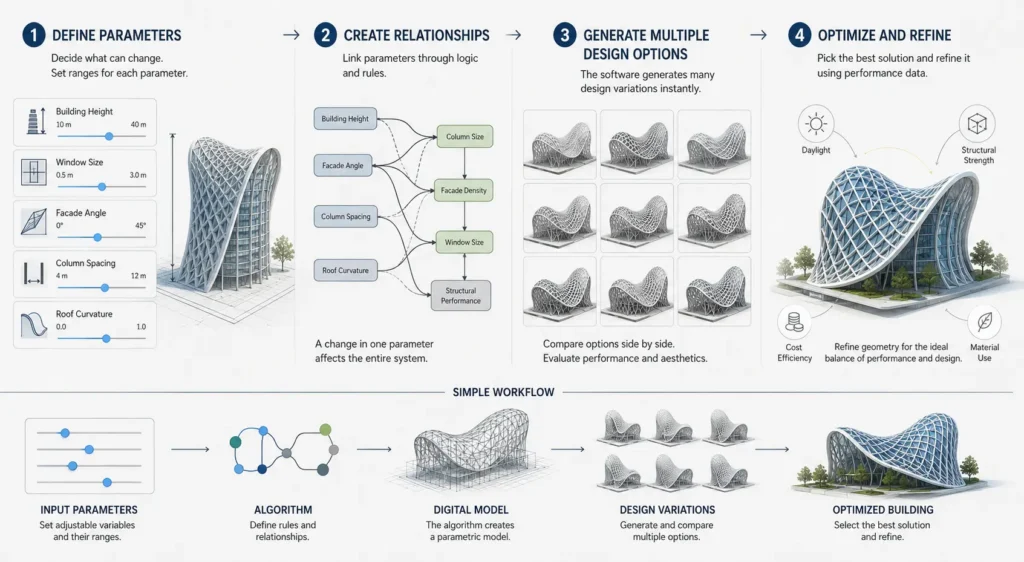
Parametric architecture works by defining rules first. These rules set how design elements connect. If you tweak something—maybe the height or the spacing—the model shifts automatically.
You’re not sketching every single detail by hand anymore. You build a system instead. The system generates the details for you.
Step 1 — Define Parameters
First, you decide what can change. This might be building height, window size, or wall angle. These become your design parameters.
Each parameter gets a range. Say you want the height anywhere between 10 and 40 meters—it just works. The software uses this range to generate options.
Step 2 — Create Relationships
Next, you link parameters together. A taller building might need wider columns. This step is where algorithmic design logic comes in.
All these connections make a network, so even a tiny adjustment moves through the whole design. Nothing updates in isolation.
Step 3 — Generate Multiple Design Options
This is when things get interesting. The software generates many design variations instantly. This is called parametric modeling.
You compare these options side by side. Some may be more efficient. Others may look more striking.
Step 4 — Optimize and Refine
In the end, you pick the best solution. You might optimize for daylight, cost, or strength. This step blends design with engineering data.
Geometry tools let you refine the shape until it’s just right. You end up with a building that not only works better but looks better, too.
Which Software Is Used for Parametric Architecture?
The most popular tool for parametric architecture is Rhino 3D with Grasshopper. There are other programs out there that help with simulation, visualisation, and digital fabrication too.
Every tool brings something special to the table. Most students pick one to start with and go from there.
Rhino 3D
Rhino 3D works as a flexible 3D modeling program, and architects rely on it to create complex curved shapes. It’s known for precision and control.
Grasshopper
Grasshopper architecture is a plugin for Rhino. It lets you build parametric logic visually. You connect nodes instead of writing code.
Revit + Dynamo
Revit is common in professional practice. Dynamo adds parametric logic on top of it. This combo suits building information modeling workflows.
Blender Geometry Nodes
Blender is free and open-source. Its Geometry Nodes system supports parametric workflows too. It makes a great option if you want a low-cost place to begin.
Which Software Should Beginners Learn?
But honestly, go for Rhino and Grasshopper first. They’re what you’ll see in most classes, and they set the industry standard. Once comfortable, explore Revit, Dynamo, or Blender.
| Software | Best For | Beginner Friendly | Industry Use |
| Rhino 3D | Complex modeling | Yes | High |
| Grasshopper | Parametric logic | Yes | High |
| Revit + Dynamo | BIM workflows | Moderate | High |
| Blender Geometry Nodes | Free experimentation | Yes | Growing |
For a deeper dive into architecture technology, read our article on architecture software for B.Arch students.
What Are Some Real-World Examples of Parametric Architecture?
Many famous buildings use parametric architecture. These shapes are almost impossible to draw by hand. This approach also makes structures stronger and more sustainable.
It’s easier to understand the idea when you see real examples. Here are a few that stand out.
Heydar Aliyev Center
In Baku, there’s a building with smooth, flowing curves—almost like waves. Architect Zaha Hadid used parametric design tools to create it. The design blurs the boundary between the building and its surroundings.
For a deeper look at how parametric thinking shaped this project, explore Dezeen’s detailed case study of the Heydar Aliyev Centre.
Beijing National Stadium
There’s also the stadium called the Bird’s Nest. Its complex steel lattice came together with help from parametric techniques. It balances strength with a striking visual pattern.
Al Bahar Towers
In Abu Dhabi, you’ll find towers with a facade that actually moves, changing its pattern as the sunlight shifts during the day. This is contemporary architecture solving a real climate problem.
Why These Projects Matter
These buildings show more than style. They prove parametric methods solve real engineering challenges. That kind of innovation really makes an impression on students.
| Building | Architect | Parametric Benefit |
| Heydar Aliyev Center | Zaha Hadid Architects | Complex curved geometry |
| Beijing National Stadium | Herzog & de Meuron | Optimized structural lattice |
| Al Bahar Towers | Aedas | Climate-responsive facade |
Is Parametric Architecture a Good Career Choice for Students?
Learning parametric architecture builds valuable digital skills. These skills are sought after in architecture, engineering, and urban design. Computational roles are also growing fast.
Picture this. A third-year student named Meera struggled with a studio brief. Her tower design felt flat compared to her classmates’ work.
She learned basic Grasshopper over the weekend. Her next model responded to sunlight and wind direction automatically. Her professor noticed the shift immediately.
That one skill changed how her portfolio looked. It also changed how confident she felt in reviews.
Career Paths
- Computational designer
- Parametric architect
- Digital fabrication specialist
- Urban design analyst
- BIM and design technology consultant
Skills Employers Value
- Logical, systems-based thinking
- Software fluency in Grasshopper or Dynamo
- Ability to solve design problems with data
- Strong visual and technical communication
Portfolio Benefits
Parametric projects stand out visually. They also show technical depth beyond sketching. This combination impresses both professors and employers.
For more context, read our article on the future of architecture in India.

What Does the Future Hold for Parametric Architecture?
Parametric architecture will keep growing in importance. AI, digital fabrication, and sustainability are reshaping the profession. Generative tools are speeding up this shift.
Students who learn this now gain an early advantage. The field is only getting more technical.
AI-Assisted Design
AI tools now suggest design options automatically. This builds directly on parametric logic. Generative design is becoming a natural next step.
Sustainable Architecture
Parametric tools help test energy performance early. This supports greener, more efficient buildings. Sustainability and computation now go hand in hand.
To see how sustainability is shaping real-world practice, review the British Council’s research on climate-adaptive architecture.
Smart Cities
Urban planners use parametric models for entire neighborhoods. This helps manage traffic, light, and density. Architecture technology is scaling beyond single buildings.
Related: artificial intelligence in architecture and 10 trends of architecture in 2026.
Frequently Asked Questions
-
What is parametric architecture and how does it work?
Parametric architecture uses algorithms and changeable rules to design buildings. If you tweak a parameter, the model updates right away. This gives you flexible, data-driven designs.
-
What is parametric design and why is it important?
Parametric design makes architecture more efficient and creative. Architects can try out many ideas fast. This leads to smarter, more optimised buildings.
-
Which software should architecture students learn for parametric design?
Try starting with Rhino 3D and Grasshopper. They’re easy for beginners and pretty popular in the field. You’ll build a solid foundation for other tools later on.
-
Is parametric architecture a good career for architecture students?
This path teaches you digital skills that are in high demand. It strengthens portfolios and opens computational design roles. The need for these skills just keeps growing.
Key Takeaways
- Parametric architecture uses algorithms and adjustable rules. This makes design more flexible.
- It lets architects test many ideas fast. It also keeps them precise.
- Rhino 3D and Grasshopper are solid choices if you’re just getting started.
- This skill can boost your portfolio. It can also open up career options.
- AI, sustainability, and computation will shape architecture’s future.
Take a look at how TKM School of Architecture brings together digital design, computational thinking, and hands-on studio learning. You’ll get to explore their B.Arch program, check out student projects, and see what future-focused architectural education looks like.